After a break in order to focus on some other areas I’m back and picking up where I left off.
The goal going forward is to get more interaction with artists and showcase their efforts. Please feel free to share your ideas and thoughts with me. Art is such a successful way to share ideas and demonstrate deep feelings about something and my goal is to encourage the use of art to peacefully protest the thoughts, events, and ideas that we believe are causing damage.
TODAY’S TOPIC : Books (stories and movies)that made a difference and affected positive change: Ken Kesey’s “One Flew Over The Cuckoo’s Nest” and Nelly Bly’s “10 Days in a Mad-House”. (note: some references to LSD and other drugs are present in the interviews linked)
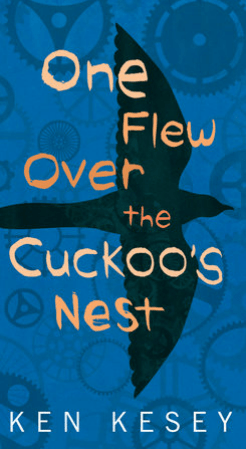
“One flies east, one flies west, and one flies over the cuckoo’s nest”.
‘One Flew Over The Cuckoo’s Nest’ is a novel originally published in 1961, written by Ken Kesey, a counter-culture novelist with an interesting history of his experiences in the 60’s. From excelling in creative writing to unknowingly and unwillingly being included in a government experiment that included the use of LSD and other hallucinogenic drugs. (https://en.wikipedia.org/wiki/MKUltra).
This story still seems to hold relevance and demonstrates the damaging effects of becoming institutionalized.
“At the invitation of Stanford psychology graduate student Vik Lovell, an acquaintance of Allen Ginsberg, Ken Kesey volunteered to take part in what turned out to be a CIA-financed study under the aegis of MKUltra,[61] at the Menlo Park Veterans’ Hospital[62][63] where he worked as a night aide.[64] The project studied the effects of psychoactive drugs, particularly LSD, psilocybin, mescaline, cocaine, AMT and DMT on people.[65]“
Here’s how he described the experience which then inspired him to write the book:

“Well, Allen Ginsberg says, you know who was paying for that? It was the CIA. I said aw, no Allen, you’re just paranoid. But he finally got all the darn records, and it did turn out the CIA was doing this. And it wasn’t being done to try to cure insane people, which is what we thought. It was being done to try to make people insane—to weaken people, and to be able to put them under the control of interrogators.
We didn’t find this out for 20 years. And by that time the government had said OK, stop that experiment. All these guinea pigs that we’ve sent up there into outer space, bring them back down and don’t ever let them go back in there again because we don’t like the look in their eyes.” https://www.kerouac.com/ken-kesey-interview-fresh-air-1989
This article in Mental Health magazine, written by H. Steven Moffic, MD, explains the meaning and importance of the story and some of the changes that have happened because of it:
https://www.psychiatrictimes.com/view/we-are-still-flying-over-cuckoos-nest
A couple of excerpts from the article:
Ever since seeing the movie, I was fascinated by the title. Why was the excerpt from a nursery rhyme highlighted? Cuckoo is slang for crazy, which, in turn, is slang for the mentally ill. One goes one way, one goes in the opposite direction, one flies over the nest, but the implication is that whoever is in the cuckoo’s nest is not nourished. Is the lack of nourishment of the mentally ill by would-be helpers going off in all directions but not integrating for what is needed what Kesey wanted to convey to us?
“In the movie, the power and authority seem to reside with the nurse(s) rather than the psychiatrists. With the loss of hospital beds and the availability of only brief stays, it is unclear where the leadership now resides.”
The good that came of this book and the research done by doctors and psychologists, is that wide reforms were implemented and patients developed more rights than they previously had. Now patients must be treated humanely and not hurt or injured by their treatments.
A HISTORY OF UNDERCOVER WORK:
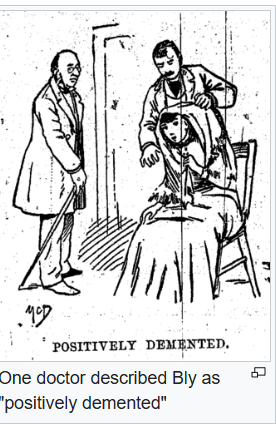
One of the first persons considered sane and reasonable to attempt to go undercover in a mental institution and write about it, was reporter Nelly Bly in the late 1800’s, who was working undercover for the New York World. Bly was successfully “involuntarily committed” to an insane asylum for 10 days and lived and was treated as a patient before being released when her contacts at “The World” were able to secure her release. She then published her articles chronically her experiences in a book titled “Ten Days in a Mad-House”. https://en.wikipedia.org/wiki/Ten_Days_in_a_Mad-House
Notable excerpts: “Once admitted to the asylum, Bly abandoned any pretense at mental illness and began to behave as she would normally. The hospital staff seemed unaware that she was no longer “insane” and instead began to report her ordinary actions as symptoms of her illness. Even her pleas to be released were interpreted as further signs of mental illness. Speaking with her fellow patients, Bly was convinced that some were as “sane” as she was.“
“I left the insane ward with pleasure and regret–pleasure that I was once more able to enjoy the free breath of heaven; regret that I could not have brought with me some of the unfortunate women who lived and suffered with me, and who, I am convinced, are just as sane as I was and am now myself.“
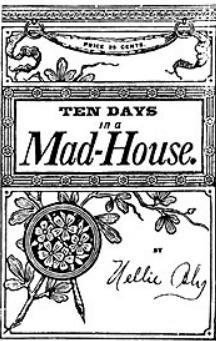
“Once admitted to the asylum, Bly abandoned any pretense at mental illness and began to behave as she would normally. The hospital staff seemed unaware that she was no longer “insane” and instead began to report her ordinary actions as symptoms of her illness. Even her pleas to be released were interpreted as further signs of mental illness. Speaking with her fellow patients, Bly was convinced that some were as “sane” as she was.“
There is also some inspiration in the story from the famous “Rosenhan Experiment” where students were admitted to mental health facilities based on false diagnoses. Once admitted they were instructed to just act normal. The intention was to see how long it took the staff to realize they were faking. What happened was that ALL of the students who were committed were diagnosed with having psychiatric disorders and treated as such. However, 35 of the 118 actual patients ‘expressed suspicions that the pseudo-patients were sane”. The experiment ended up causing a significant amount of mental harm to the participants and this type of study is no longer considered reasonable or ethical.
https://en.wikipedia.org/wiki/Rosenhan_experiment
The story in the book he went on to write, is about a criminal attempting to avoid going to prison by pretending to be mentally unfit. He succeeds in being committed to a mental hospital but soon finds that it’s not going to be as easy to survive the experience as he thought. Throughout the story we see that the patients are treated as though they are less than human and subjected to a high level of mental and physical abuse.
I would love to say unequivocally that these types of experiments could never happen again, but I don’t believe that’s true. We continue to see people as we believe them to be while casually throwing around psychiatric terms that are usually poorly understood.
(note: all links, interviews, and images are covered under their respective owner’s copyrights. They are shared here for educational purposes).
 The Art of Peaceful Protest